


Thursday, November 12, 2026

Lisa Gray

687 POSTS 0 COMMENTS
Lisa is an accomplished marketer with years of expertise in direct response marketing, digital marketing, data analytics and business development working with both B2C and B2B.

    Real estate agent having a helpful conversation with homeowners in a slower market

    Real estate conversations in a slower market should focus less on creating urgency and more on understanding what is keeping people from moving forward.

    When fewer people feel ready to buy or sell, agents often respond by increasing their marketing volume. More emails. More posts. More calls. More messages asking whether someone is ready to move.

    Homeowners who feel uncertain rarely need additional pressure. They need a useful reason to talk.

    That changes the agent’s immediate objective. Instead of trying to turn every contact into an appointment, create conversations that reveal what people are considering.

    Lead with curiosity

    “Are you thinking about selling?” is easy to dismiss.

    More thoughtful questions create room for a genuine answer:

    • What would need to change before moving became worthwhile?
    • Are you more concerned about selling your current home or finding the next one?
    • Has anything in the neighborhood changed how you think about your property?
    • Would knowing your current options make the decision easier?

    The goal is not to manufacture urgency. It is to understand the decision behind the hesitation.

    Bring something local to the conversation

    Broad housing headlines rarely describe every neighborhood.

    An agent can provide greater value by discussing nearby activity, changing buyer expectations, local inventory, property condition, or the types of homes attracting attention.

    Firsthand context gives homeowners information they cannot obtain from a national prediction alone.

    Follow the concern, not the script

    One homeowner may be worried about giving up a favorable mortgage. Another may need more space, less maintenance, or help coordinating a move.

    A useful follow-up reflects what the person actually said. It does not force every homeowner into the same automated sequence.

    Let marketing open the door

    A postcard, email, or neighborhood update does not have to close a transaction. It can introduce an observation, raise a relevant question, or make an agent easier to remember when circumstances change.

    That is especially important in a slower market. Momentum may begin long before someone is ready to sign an agreement.

    Agents cannot force transaction volume to increase. They can become more present, more curious, and more useful.

    Better conversations uncover the decisions homeowners are already considering. Those conversations create relationships, and relationships create opportunities that another generic sales message may never reveal.

    The Get More Listings postcards and scheduled campaigns help you stay visible with homeowners and give potential sellers a natural reason to think about their next move.

    Explore the Get More Listings postcards and scheduled campaigns now.

    Homes & Life Magazine

    A customizable magazine with compelling content that keeps you top-of-mind.


    Magazine →

    Business Plan

    Interactive Business Plan

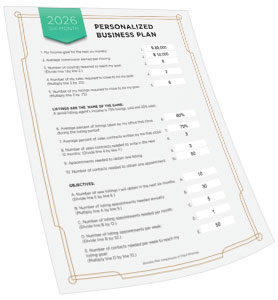
    Map out your next six months with a simple planner built for real estate success.


    Get the Plan →


      Real estate agent preparing for a price reduction conversation with sellers

      Few conversations are more uncomfortable than having a price reduction conversation with sellers.

      The seller may hear, “Your home is worth less than you thought.” The agent may worry that the recommendation will sound like a failure of the original strategy.

      That tension becomes harder when price was discussed as a single promise rather than an evolving market decision.

      A better approach begins before the listing goes live.

      Establish a range, not just a number

      A comparative market analysis provides evidence, but it cannot predict exactly how buyers will respond.

      Explain the likely pricing range, where the recommended price falls within it, and what the seller should expect at different points. A higher starting price may require more patience. A more competitive position may create stronger early activity.

      The seller should understand that each choice has a tradeoff.

      Agree on the signals you will monitor

      Do not wait until several quiet weeks have passed to explain what showing activity means.

      Identify the evidence you will review together:

      • Online interest and showing requests
      • Feedback from buyers and agents
      • Competing listings entering the market
      • Price adjustments on comparable homes
      • Offers, objections, and recurring condition concerns

      These signals make the next conversation about market response rather than personal opinion.

      Schedule the review before you need it

      Set an initial review date when the listing agreement is signed. This prevents the follow-up from feeling like an unexpected call delivering bad news.

      The review is not an automatic price reduction. It is a scheduled opportunity to compare the original strategy with what buyers have revealed.

      Separate the home from its market position

      Sellers often connect price with the quality of their home or the memories created there. A price adjustment does not diminish either.

      It changes how the property competes against the alternatives buyers can purchase today.

      Agents do not need to convince every seller to reduce immediately. They do need to create a decision process grounded in evidence.

      When expectations, signals, and review points are established early, a future adjustment feels less like retreating and more like responding intelligently to the market.

      Bring local evidence into the conversation. Neighborhood Update postcards help connect your name with the local knowledge homeowners need when evaluating their next move.

      How to Make a Flyer for Real Estate

      Use the same evidence-first approach when you create listing marketing. A real estate flyer should help a reader understand the property quickly and know what to do next. Use this checklist when you build a flyer for a listing, open house, or follow-up.

      Lead with the property and one clear message

      Put the listing status, address or neighborhood, and a short headline near the top. Choose one verified feature that matters to the property, such as a renovated kitchen, outdoor space, or convenient location. Keep the message specific instead of relying on words like “beautiful” or “must-see.”

      Use accurate details and strong photography

      Include only details you have confirmed, such as price, bedroom and bathroom count, square footage, open-house time, or listing status. Use one strong primary photo and additional images only when they remain clear at the final size. Remove outdated information before each reprint.

      Make the next step obvious

      Give the reader one clear action: scan a QR code to view the listing, request a showing, or contact you for details. Test the QR code on more than one phone before printing, and include your name, brokerage, phone, email, and any required disclosure.

      Match the flyer to the campaign

      A flyer can support an open house or listing conversation, while a postcard can keep your name visible with a targeted group of homeowners. If you want to extend a listing message beyond the property, review ProspectsPLUS! real estate postcards and choose a format and audience that fit the campaign.

      Before printing, review every fact, confirm the destination behind the QR code, and look at a proof at its final size. The goal is a clear, accurate piece that helps the right reader take the next step.

      Explore Neighborhood Update postcards.

        When sellers receive an offer, their eyes naturally move toward one number: the price.

        But in a market where concessions are becoming more common, the highest number at the top of the page may not represent the strongest overall offer.

        A buyer might request assistance with closing costs, a mortgage-rate buydown, repair credits or another expense. The offer may also include financing, appraisal and inspection conditions that affect its likelihood of reaching closing.

        That does not automatically make the offer unattractive. It means the seller needs to evaluate the complete package.

        Agents can make that process easier by organizing each offer around several practical questions:

        What is the estimated net?
        Compare the offer price with requested concessions and other seller-paid expenses.

        How dependable is the financing?
        Review the preapproval, loan type and any conditions that could affect the transaction.

        How much uncertainty is involved?
        Consider inspection, appraisal, home-sale and financing contingencies.

        Does the timing work?
        A slightly lower offer with a suitable closing date or greater flexibility may solve an important problem for the seller.

        What does the local market support?
        Concessions vary considerably between cities, neighborhoods and price ranges. National statistics provide context, but nearby transactions provide the more useful comparison.

        The goal is not to persuade sellers to accept every request. It is to help them understand what they are receiving in exchange.

        A concession that protects the price and moves a qualified buyer toward closing may be reasonable. A complicated offer with weak financing and multiple opportunities to withdraw may remain risky, even if its headline price looks impressive.

        These discussions are also easier when trust already exists. Sellers are more receptive to difficult advice when the agent has established familiarity and demonstrated local knowledge before the listing appointment.

        The strongest offer is ultimately the one that best supports the seller’s financial needs, timing, and tolerance for uncertainty, not necessarily the one with the largest number printed at the top.

        Evaluating offers, concessions and contingencies requires an agent homeowners already know and trust.

        Looking for Listings postcards help you introduce yourself to prospective sellers, remain visible in your market and invite homeowners to start a conversation before they are ready to list.

        When the decisions become more complicated, your name is already familiar.

        Explore Looking For Listings Postcards

        Homes & Life Magazine

        A customizable magazine with compelling content that keeps you top-of-mind.


        Magazine →

        Business Plan

        Interactive Business Plan

        Map out your next six months with a simple planner built for real estate success.


        Get the Plan →


          Referrals are one of the best sources of real estate business. They begin with trust, arrive with credibility and often produce warmer conversations than purchased leads.

          They are also unpredictable.

          An agent can provide exceptional service, stay connected with past clients and ask for introductions, but referrals still tend to arrive on someone else’s schedule. When transaction volume slows, waiting for the next one can leave too much of the pipeline to chance.

          The answer is not to stop nurturing your sphere. It is to complement referrals with consistent homeowner visibility.

          Homeowners rarely announce the moment they begin thinking about selling. The process may start quietly with a change in employment, a growing family, rising home-maintenance demands or curiosity about what their property might be worth.

          At this early stage, most homeowners are not completing a lead form or interviewing agents. They are noticing who appears knowledgeable, active and familiar.

          That gives agents an opportunity to become recognizable before the listing conversation begins.

          Effective visibility does not require every message to ask for an appointment. It can:
          • Address a question homeowners are already considering.
          • Explain what is changing in the local market.
          • Offer help without assuming someone is ready to sell.
          • Keep the agent’s name, face and expertise familiar.
          • Provide a clear reason to begin a conversation.

          Consistency matters because one marketing piece cannot predict the exact week a homeowner becomes interested. Regular communication increases the likelihood that your name will already feel familiar when that moment arrives.

          This is where direct mail can support the rest of an agent’s relationship marketing. It reaches homeowners in a defined area, remains visible beyond a quick screen impression and gives recipients something tangible to associate with the agent.

          Referrals should remain part of the plan. But they should not be the entire plan.

          The most stable marketing approach combines trusted relationships with deliberate visibility. Referrals connect you with people who are already talking. Consistent outreach helps you become known by the homeowners who have not started talking yet.

          Get More Listings II postcards give you another way to stay visible, introduce your value and encourage homeowners to think of you when selling becomes a real possibility.

          Explore Get More Listings postcards and campaigns now

          Homes & Life Magazine

          A customizable magazine with compelling content that keeps you top-of-mind.


          Magazine →

          Business Plan

          Interactive Business Plan

          Map out your next six months with a simple planner built for real estate success.


          Get the Plan →


            One headline says buyers are gaining leverage. Another says homes are still attracting multiple offers. Builders are cutting prices in some markets, while limited inventory keeps competition intense in others.

            All of those stories can be true at the same time.

            Real estate conditions vary by neighborhood, price range, property type and even the condition of individual homes. A national statistic can provide context, but it cannot tell a homeowner what is happening on their street.

            That distinction creates an opportunity for agents.

            Do not simply forward another housing article. Translate it.

            Begin by selecting a few local indicators that homeowners can understand:
            • Current inventory compared with recent months
            • Typical market time
            • Recent price adjustments
            • The difference between original list and closing prices
            • Buyer activity within specific price ranges
            • Concessions appearing in recent transactions

            Then explain what those indicators mean.

            If inventory is increasing, sellers may need to compete more carefully on price and presentation. If well-positioned homes are still selling quickly, homeowners should understand which qualities separate those listings from the ones accumulating market time.

            Buyers need the same interpretation. More listings may create negotiating room, but that room will not exist equally across every neighborhood or property type.

            The objective is not to overwhelm people with numbers. It is to answer the question behind the numbers: “What does this mean for me?”

            This is also where agents can differentiate themselves from portals and automated market summaries. Technology can produce a chart. A knowledgeable local professional can explain why the chart moved, where the exceptions are and how those conditions should influence an individual decision.

            Use national news as the opening of the conversation not its conclusion.

            When clients encounter conflicting real estate headlines, the agent who calmly brings the discussion back to relevant local evidence becomes more credible, more useful and easier to remember.

            National housing news may attract attention, but homeowners want to understand what current conditions mean for their own plans.

            The Market Update Series gives you a timely reason to reach out, share useful perspective and position yourself as the local professional who can help homeowners interpret a changing market.

            Explore the Market Update Series of postcards

            Homes & Life Magazine

            A customizable magazine with compelling content that keeps you top-of-mind.


            Magazine →

            Business Plan

            Interactive Business Plan

            Map out your next six months with a simple planner built for real estate success.


            Get the Plan →


              The fall market may offer something buyers have struggled to find: breathing room.

              More listings, fewer competing offers and increasingly motivated sellers can make this part of the year attractive. But elevated mortgage rates still affect monthly payments, and affordability does not improve simply because competition declines.

              This is where a knowledgeable agent becomes especially valuable.

              Instead of telling hesitant buyers that now is the “perfect” time, help them understand what has changed—and what has not.

              Start with choices. A buyer who dismissed the market earlier may now find more properties within a workable range. Encourage clients to compare several homes instead of searching for one perfect listing. A property with an older kitchen, longer commute or smaller yard might offer a better price or leave room for negotiation.

              Next, look beyond the asking price. Seller concessions, closing-date flexibility and property condition can materially affect the transaction. Buyers should discuss financing structures and monthly-payment scenarios with a qualified lender before deciding whether an opportunity is genuinely affordable.

              Finally, define the buyer’s decision threshold. Ask:

              • What monthly payment feels sustainable?
              • How long do you expect to own the home?
              • Which features are essential?
              • What would make waiting more beneficial?
              • What would make acting now worthwhile?

              These questions help buyers replace general anxiety with a personal decision framework.

              Some clients will conclude that waiting remains appropriate. Others may discover that today’s additional choices compensate for the financing environment. Both are responsible outcomes.

              Agents do not need to predict where rates or prices will go. Their advantage lies in helping clients compare the options available now.

              A fall buying window is not a command to purchase. It is an invitation to look again with better information, clearer priorities and an agent who can translate changing conditions into a decision the buyer understands.

              Multi-Property Postcards can help you present a broader view of the homes and possibilities within your market while keeping your name and expertise visible. Use that visibility to invite buyers back into a thoughtful, informed conversation.

              Explore Multi-Property Photos

              Homes & Life Magazine

              A customizable magazine with compelling content that keeps you top-of-mind.


              Magazine →

              Business Plan

              Interactive Business Plan

              Map out your next six months with a simple planner built for real estate success.


              Get the Plan →


                AI can now brighten a room, replace furniture, improve landscaping, remove an unwanted feature, or create a polished property image in seconds.

                Used responsibly, these tools can help buyers visualize a home’s potential. Used carelessly, they can create a gap between what buyers see online and what they encounter at the property.

                That gap has consequences.

                Buyers have publicly criticized listings in which altered images made rooms appear larger or removed features that existed in the real home. California has responded with disclosure requirements for certain digitally altered listing photographs.

                For agents, the larger lesson extends beyond photography: as artificial content becomes easier to create, authentic information becomes more valuable.

                Homeowners want to know that the person advising them understands the neighborhood, can explain the market, and will present their property honestly. They want guidance grounded in reality—not merely content that looks impressive.

                Agents can demonstrate that credibility in several ways:

                • Clearly disclose virtual staging or material image changes.
                • Retain and provide original photographs where appropriate.
                • Publish local observations that could only come from knowing the community.
                • Explain both opportunities and challenges instead of presenting every market as “hot.”
                • Use real client questions as the basis for educational content.
                • Keep their face, voice, contact information, and message consistent across channels.

                Direct mail can be especially valuable here. A useful market update, neighborhood publication, or homeowner guide is tangible. It connects the agent’s name with relevant information without depending on an algorithm—or an artificially perfected image—to earn attention.

                AI will continue to become part of real estate marketing. The winning strategy is not to reject it completely. It is to ensure that technology never makes the agent feel less believable.

                In a market filled with polished content, trust may be the most human—and most valuable—advantage an agent has.

                The Real Estate Times is a newspaper-style postcard series featuring prominent headlines and timely real estate topics designed to capture homeowners’ attention.

                Each postcard gives you a relevant reason to reach out, share useful perspective, and keep your name connected to the market conversations homeowners are already having.

                Explore the Real Estate Times Series

                Homes & Life Magazine

                A customizable magazine with compelling content that keeps you top-of-mind.


                Magazine →

                Business Plan

                Interactive Business Plan

                Map out your next six months with a simple planner built for real estate success.


                Get the Plan →


                  Mortgage rates are moving toward 7% again, and agents are hearing a familiar response from buyers:

                  “I think I’ll wait.”

                  That hesitation is understandable. A higher rate changes the monthly payment, reduces purchasing power, and makes an already important decision feel even heavier.

                  But “wait” is rarely a complete plan.

                  Rates may decline, remain elevated, or move higher. Home prices and available inventory can also change while a buyer is watching from the sidelines. No agent can responsibly promise which combination will appear next.

                  What agents can provide is clarity.

                  Start by helping buyers separate the market factors they cannot control from the decisions they can. They can establish a comfortable monthly-payment range, compare financing structures with a qualified lender, identify neighborhoods where their budget reaches further, and decide which compromises they are—or are not—willing to make.

                  This changes the conversation from “Is this the perfect market?” to “What would need to be true for buying to make sense for you?”

                  Some buyers will discover that waiting is still the right choice. Others may find that seller concessions, a price adjustment, a different property type, or a longer ownership horizon changes the equation.

                  Either outcome is valuable. The purpose is not to manufacture urgency. It is to help people replace uncertainty with a decision they understand.

                  This is also an important marketing lesson. Homeowners and buyers do not need another sweeping prediction about where rates are headed. They need an agent who can explain what today’s conditions mean for their particular situation.

                  The agents who provide that perspective become useful before someone is ready to transact. And when the decision finally becomes clearer, useful is much easier to remember than promotional.

                  Call to Action postcards help you reach your market with approachable messages designed to encourage that next step—whether someone has a real estate question, is reconsidering their plans, or simply wants local guidance.

                  Launch a Call To Action Scheduled Campaign.

                  Homes & Life Magazine

                  A customizable magazine with compelling content that keeps you top-of-mind.


                  Magazine →

                  Business Plan

                  Interactive Business Plan

                  Map out your next six months with a simple planner built for real estate success.


                  Get the Plan →


                    When the market becomes unpredictable and new listings are harder to find, it is natural to start searching for more leads.

                    But sometimes the safest place to look for your next opportunity is not farther away. It is among the people who already know you.

                    Your sphere of influence is more than a collection of names. It includes former clients, friends, neighbors, colleagues, local business owners, and others who have already formed an opinion about you.

                    You are not introducing yourself to these people. You are building on trust that already exists.

                    Trust Becomes More Valuable in an Uncertain Market

                    A shifting market creates questions for homeowners.

                    Should they sell now or wait? What is their home worth? Will they be able to find another home? What do higher rates or changing inventory mean for their plans?

                    When people feel uncertain, they are more likely to turn to someone familiar. That gives agents who have continued nurturing their relationships a meaningful advantage.

                    Your sphere may produce a direct opportunity, but it can also connect you to a friend, relative, or neighbor who needs guidance. One helpful conversation can lead to another.

                    Be the Steady Voice They Remember

                    Staying connected does not mean constantly asking people if they are ready to buy or sell. It means continuing to demonstrate that you are present, informed, and willing to help.

                    Share useful market information. Check in personally. Remember important details. Send something that makes them smile. Remind them that they can contact you whenever real estate questions arise.

                    These small touches help turn past relationships into lasting ones.

                    A Safe Harbor Is Still Maintained

                    Your sphere cannot be treated like a list you contact only when business slows down. Trust needs continued attention.

                    Create a manageable communication schedule that includes direct mail, personal calls, emails, and occasional face-to-face contact. Keep notes so your communication reflects who people are—not simply what they might be worth as a lead.

                    You do not always need more leads. Sometimes, you need to do more with the relationships you already have.

                    When listings are difficult to find, your sphere can provide something the broader market cannot: a community of people who already know, like, and trust you.

                    Stay close. Stay helpful. Become the steady real estate resource they know they can count on.

                    Send it once or let us keep the campaign going for you.

                    Explore the Shifting Market Series.

                    Homes & Life Magazine

                    A customizable magazine with compelling content that keeps you top-of-mind.


                    Magazine →

                    Business Plan

                    Interactive Business Plan

                    Map out your next six months with a simple planner built for real estate success.


                    Get the Plan →


                      When direct mail works, it can look almost effortless. A homeowner receives a postcard, recognizes the agent, and calls when it is time to sell.

                      But that response was rarely created by one postcard.

                      It was built through repetition, relevance, and recognition.

                      Repetition Gets You Seen

                      One mailing introduces you. Repeated mailings make you familiar.

                      Homeowners may not need an agent the first, third, or even tenth time they see your name. That does not mean your marketing is failing. Each mailing is helping establish your presence and reinforcing the message that you are active, available, and invested in their community.

                      The objective is not to make someone respond every time. It is to remain visible until their timing changes.

                      Relevance Gets You Noticed

                      Repetition alone is not enough. Your message must also give homeowners a reason to pay attention.

                      Market updates, recent sales, homeowner tips, seasonal information, and answers to common real estate questions all connect your name with something useful.

                      The strongest direct mail does more than say, “I’m a real estate agent.” It demonstrates, “I understand this market, and I can help when you need me.”

                      Recognition Gets You Chosen

                      Recognition is what happens when repetition and relevance work together.

                      Your name feels familiar. Your face is easy to place. Your message is consistent. When a homeowner begins thinking about selling—or a neighbor asks if they know an agent—you are no longer a stranger asking for their business.

                      You are the agent they already know.

                      Before sending your next mailing, ask three questions:

                      • Have these homeowners seen me before?
                      • Does this message matter to them?
                      • Will they immediately recognize that it came from me?

                      Repetition without relevance becomes background noise. Relevance without repetition is easily forgotten. But when homeowners repeatedly receive useful marketing from an agent they recognize, direct mail becomes something much more valuable:

                      A place in their memory.

                      Direct mail is not magic. It is a deliberate process of becoming known before your services are needed.

                      Turn the same mailing list from your Just Sold postcard into an automated follow-up campaign that keeps building familiarity long after the listing has sold.

                      Set it once. We’ll keep you in front of them.

                      Check out the Just Sold Follow-Up Scheduled Campaign now.

                      Homes & Life Magazine

                      A customizable magazine with compelling content that keeps you top-of-mind.


                      Magazine →

                      Business Plan

                      Interactive Business Plan

                      Map out your next six months with a simple planner built for real estate success.


                      Get the Plan →


                        Real estate agents are questioning nearly every part of their marketing.

                        Are postcards still worth mailing? Should I spend money on online leads? Is geographic farming taking too long? Which activities are actually moving my business forward?

                        These are fair questions. When listings are harder to find and every marketing dollar matters, agents cannot afford to invest blindly.

                        But perhaps the better question is not simply, “Which marketing channel works?”

                        It is:

                        Does this marketing give me an advantage I did not have before?

                        Most Marketing Begins With Limited Information

                        Agents know a great deal about their local markets. They can see property values, sales histories, length of ownership, and neighborhood activity.

                        What they cannot readily see is which homeowners may be moving closer to a listing decision.

                        From the outside, two homes on the same street may look like the same opportunity. But one homeowner may be statistically far more likely to list within the coming months than the other.

                        Without that additional insight, agents are left to treat every address as though it holds equal potential. They blanket an area, select homeowners using broad demographic criteria or simply hope their message reaches someone at the right moment.

                        That does not make the marketing itself ineffective. It means the campaign starts with significant uncertainty.

                        Better Information Changes the Starting Point

                        Imagine knowing which properties in a market are showing stronger statistical signs of selling within the next 180 days.

                        You still would not know with certainty which homeowner will list. No data can promise that.

                        But you would know where opportunity is more likely to develop. That insight could help you make smarter decisions about where to concentrate your postcards, calls, follow-up, and marketing budget.

                        You may not be able to know exactly who will sell next. But you no longer have to market as though every homeowner is equally likely to.

                        That is an important distinction—especially in a market where agents need to stack the odds in their favor whenever they can.

                        What Listing Lens Reveals

                        Listing Lens analyzes more than one million data points, including over 40 years of transaction history, property information, ownership data, market conditions, and behavioral indicators.

                        It then assigns single-family homes a Sellability Score based on their statistical likelihood of selling within the next 180 days.

                        The real value is not the technology behind the score. It is the new layer of market intelligence the score gives an agent.

                        Instead of beginning with a map and a guess, an agent can begin with information that helps reveal where future listing activity may be forming.

                        The Advantage Is Measurable

                        In controlled testing across 20,000 homes in six major markets, Listing Lens targeting produced 71% more listings in the first 120 days than traditional demographic targeting. (See how Listing Lens works)

                        That result does not mean every high-scoring property will become a listing. It also does not eliminate the need for a strong message, consistent contact, and thoughtful follow-up.

                        It also shows something equally important: agents who start with better information can improve the odds that their marketing reaches a future seller.

                        Insight Becomes More Valuable When You Act on It

                        A Sellability Score alone will not win a listing.

                        The opportunity comes from using that information to build a focused campaign—reaching selected homeowners consistently, providing useful information, and becoming familiar before they make their intentions public.

                        That is where market intelligence and good marketing work together.

                        Listing Lens helps identify where an opportunity may be developing. Your marketing builds the recognition and trust that can position you to capture it.

                        What Makes Marketing Worth Doing?

                        Marketing is worth the investment when it does more than put your name in front of people.

                        It should reduce guesswork, uncover opportunities you could not otherwise identify, and help you make better decisions before you spend your money.

                        Listing Lens cannot guarantee your next listing. What it can give you is a better-informed starting point.

                        And when every listing matters, every credible advantage matters too.

                        Focus your marketing on homes showing stronger signs of selling within the next 180 days.

                        Find your list of homeowners most likely to list with Listing Lens Ai.

                        Homes & Life Magazine

                        A customizable magazine with compelling content that keeps you top-of-mind.


                        Magazine →

                        Business Plan

                        Interactive Business Plan

                        Map out your next six months with a simple planner built for real estate success.


                        Get the Plan →


                          For many homeowners, summer is a season of distraction.

                          Vacations, visitors, school schedules and family activities make it easy to postpone big decisions. Even homeowners who have considered selling may tell themselves they will revisit the idea “after summer.”

                          Then September arrives.

                          Routines return, the calendar becomes more structured, and the end of the year suddenly feels much closer.

                          Questions that have been sitting quietly in the background begin demanding answers:

                          Is this home still right for us? Should we make a move before the holidays? Would it be better to sell now or wait until spring? What is our home actually worth in today’s market?

                          That shift makes September a powerful prospecting month for real estate agents.

                          Fall Sellers Often Have a Reason to Move

                          Spring sellers may be testing the market or trying to take advantage of the traditionally busy season. Homeowners considering a fall move are more likely to be working toward a personal deadline.

                          They may want to relocate before the holidays, move closer to family, reduce their housing expenses, downsize before winter or complete a job-related move before the new year.

                          The same is often true of fall buyers. According to the National Association of REALTORS®, although fewer buyers may be active as the market moves into fall, those continuing their searches tend to be serious and prepared to act when they find the right property. That continued demand can create opportunities for well-positioned sellers. (National Association of REALTORS®)

                          The Conversation Needs to Change

                          September marketing should not pressure homeowners with messages such as “Sell now before it’s too late.”

                          Instead, it should help them answer the questions preventing them from moving forward.

                          What has changed in the local market? How much competition would their home face? What improvements should they make before listing? Could they sell and purchase another home comfortably?

                          Useful, locally relevant information gives homeowners a reason to pay attention—and a reason to contact the agent providing it.

                          Visibility Now Can Create Listings Later

                          Not every homeowner reached in September will list immediately. Some may decide to wait until late fall, after the holidays or even until spring.

                          That does not make the September conversation any less valuable.

                          By reaching out now, an agent can become part of the homeowner’s decision-making process before they start interviewing agents. Consistent postcards, neighborhood updates, market reports, and personal follow-up help build the familiarity and trust that influence who receives the call.

                          September is not simply the end of summer. It is a natural decision point.

                          The agents who recognize that shift—and give homeowners helpful reasons to start a conversation—can turn the fall seller mindset into new listing opportunities.

                          Autumn postcards give you a timely, personal way to reconnect with your farm and sphere and be remembered when homeowners are ready to talk.

                          Homes & Life Magazine

                          A customizable magazine with compelling content that keeps you top-of-mind.


                          Magazine →

                          Business Plan

                          Interactive Business Plan

                          Map out your next six months with a simple planner built for real estate success.


                          Get the Plan →