Friday, October 2, 2026

real estate marketing

    Real estate agent preparing for a price reduction conversation with sellers

    Few conversations are more uncomfortable than having a price reduction conversation with sellers.

    The seller may hear, “Your home is worth less than you thought.” The agent may worry that the recommendation will sound like a failure of the original strategy.

    That tension becomes harder when price was discussed as a single promise rather than an evolving market decision.

    A better approach begins before the listing goes live.

    Establish a range, not just a number

    A comparative market analysis provides evidence, but it cannot predict exactly how buyers will respond.

    Explain the likely pricing range, where the recommended price falls within it, and what the seller should expect at different points. A higher starting price may require more patience. A more competitive position may create stronger early activity.

    The seller should understand that each choice has a tradeoff.

    Agree on the signals you will monitor

    Do not wait until several quiet weeks have passed to explain what showing activity means.

    Identify the evidence you will review together:

    • Online interest and showing requests
    • Feedback from buyers and agents
    • Competing listings entering the market
    • Price adjustments on comparable homes
    • Offers, objections, and recurring condition concerns

    These signals make the next conversation about market response rather than personal opinion.

    Schedule the review before you need it

    Set an initial review date when the listing agreement is signed. This prevents the follow-up from feeling like an unexpected call delivering bad news.

    The review is not an automatic price reduction. It is a scheduled opportunity to compare the original strategy with what buyers have revealed.

    Separate the home from its market position

    Sellers often connect price with the quality of their home or the memories created there. A price adjustment does not diminish either.

    It changes how the property competes against the alternatives buyers can purchase today.

    Agents do not need to convince every seller to reduce immediately. They do need to create a decision process grounded in evidence.

    When expectations, signals, and review points are established early, a future adjustment feels less like retreating and more like responding intelligently to the market.

    Bring local evidence into the conversation. Neighborhood Update postcards help connect your name with the local knowledge homeowners need when evaluating their next move.

    Explore Neighborhood Update postcards.

      One headline says buyers are gaining leverage. Another says homes are still attracting multiple offers. Builders are cutting prices in some markets, while limited inventory keeps competition intense in others.

      All of those stories can be true at the same time.

      Real estate conditions vary by neighborhood, price range, property type and even the condition of individual homes. A national statistic can provide context, but it cannot tell a homeowner what is happening on their street.

      That distinction creates an opportunity for agents.

      Do not simply forward another housing article. Translate it.

      Begin by selecting a few local indicators that homeowners can understand:
      • Current inventory compared with recent months
      • Typical market time
      • Recent price adjustments
      • The difference between original list and closing prices
      • Buyer activity within specific price ranges
      • Concessions appearing in recent transactions

      Then explain what those indicators mean.

      If inventory is increasing, sellers may need to compete more carefully on price and presentation. If well-positioned homes are still selling quickly, homeowners should understand which qualities separate those listings from the ones accumulating market time.

      Buyers need the same interpretation. More listings may create negotiating room, but that room will not exist equally across every neighborhood or property type.

      The objective is not to overwhelm people with numbers. It is to answer the question behind the numbers: “What does this mean for me?”

      This is also where agents can differentiate themselves from portals and automated market summaries. Technology can produce a chart. A knowledgeable local professional can explain why the chart moved, where the exceptions are and how those conditions should influence an individual decision.

      Use national news as the opening of the conversation not its conclusion.

      When clients encounter conflicting real estate headlines, the agent who calmly brings the discussion back to relevant local evidence becomes more credible, more useful and easier to remember.

      National housing news may attract attention, but homeowners want to understand what current conditions mean for their own plans.

      The Market Update Series gives you a timely reason to reach out, share useful perspective and position yourself as the local professional who can help homeowners interpret a changing market.

      Explore the Market Update Series of postcards

      Homes & Life Magazine

      A customizable magazine with compelling content that keeps you top-of-mind.


      Magazine →

      Business Plan

      Interactive Business Plan

      Map out your next six months with a simple planner built for real estate success.


      Get the Plan →


        The fall market may offer something buyers have struggled to find: breathing room.

        More listings, fewer competing offers and increasingly motivated sellers can make this part of the year attractive. But elevated mortgage rates still affect monthly payments, and affordability does not improve simply because competition declines.

        This is where a knowledgeable agent becomes especially valuable.

        Instead of telling hesitant buyers that now is the “perfect” time, help them understand what has changed—and what has not.

        Start with choices. A buyer who dismissed the market earlier may now find more properties within a workable range. Encourage clients to compare several homes instead of searching for one perfect listing. A property with an older kitchen, longer commute or smaller yard might offer a better price or leave room for negotiation.

        Next, look beyond the asking price. Seller concessions, closing-date flexibility and property condition can materially affect the transaction. Buyers should discuss financing structures and monthly-payment scenarios with a qualified lender before deciding whether an opportunity is genuinely affordable.

        Finally, define the buyer’s decision threshold. Ask:

        • What monthly payment feels sustainable?
        • How long do you expect to own the home?
        • Which features are essential?
        • What would make waiting more beneficial?
        • What would make acting now worthwhile?

        These questions help buyers replace general anxiety with a personal decision framework.

        Some clients will conclude that waiting remains appropriate. Others may discover that today’s additional choices compensate for the financing environment. Both are responsible outcomes.

        Agents do not need to predict where rates or prices will go. Their advantage lies in helping clients compare the options available now.

        A fall buying window is not a command to purchase. It is an invitation to look again with better information, clearer priorities and an agent who can translate changing conditions into a decision the buyer understands.

        Multi-Property Postcards can help you present a broader view of the homes and possibilities within your market while keeping your name and expertise visible. Use that visibility to invite buyers back into a thoughtful, informed conversation.

        Explore Multi-Property Photos

        Homes & Life Magazine

        A customizable magazine with compelling content that keeps you top-of-mind.


        Magazine →

        Business Plan

        Interactive Business Plan

        Map out your next six months with a simple planner built for real estate success.


        Get the Plan →


          When the market becomes unpredictable and new listings are harder to find, it is natural to start searching for more leads.

          But sometimes the safest place to look for your next opportunity is not farther away. It is among the people who already know you.

          Your sphere of influence is more than a collection of names. It includes former clients, friends, neighbors, colleagues, local business owners, and others who have already formed an opinion about you.

          You are not introducing yourself to these people. You are building on trust that already exists.

          Trust Becomes More Valuable in an Uncertain Market

          A shifting market creates questions for homeowners.

          Should they sell now or wait? What is their home worth? Will they be able to find another home? What do higher rates or changing inventory mean for their plans?

          When people feel uncertain, they are more likely to turn to someone familiar. That gives agents who have continued nurturing their relationships a meaningful advantage.

          Your sphere may produce a direct opportunity, but it can also connect you to a friend, relative, or neighbor who needs guidance. One helpful conversation can lead to another.

          Be the Steady Voice They Remember

          Staying connected does not mean constantly asking people if they are ready to buy or sell. It means continuing to demonstrate that you are present, informed, and willing to help.

          Share useful market information. Check in personally. Remember important details. Send something that makes them smile. Remind them that they can contact you whenever real estate questions arise.

          These small touches help turn past relationships into lasting ones.

          A Safe Harbor Is Still Maintained

          Your sphere cannot be treated like a list you contact only when business slows down. Trust needs continued attention.

          Create a manageable communication schedule that includes direct mail, personal calls, emails, and occasional face-to-face contact. Keep notes so your communication reflects who people are—not simply what they might be worth as a lead.

          You do not always need more leads. Sometimes, you need to do more with the relationships you already have.

          When listings are difficult to find, your sphere can provide something the broader market cannot: a community of people who already know, like, and trust you.

          Stay close. Stay helpful. Become the steady real estate resource they know they can count on.

          Send it once or let us keep the campaign going for you.

          Explore the Shifting Market Series.

          Homes & Life Magazine

          A customizable magazine with compelling content that keeps you top-of-mind.


          Magazine →

          Business Plan

          Interactive Business Plan

          Map out your next six months with a simple planner built for real estate success.


          Get the Plan →


            When direct mail works, it can look almost effortless. A homeowner receives a postcard, recognizes the agent, and calls when it is time to sell.

            But that response was rarely created by one postcard.

            It was built through repetition, relevance, and recognition.

            Repetition Gets You Seen

            One mailing introduces you. Repeated mailings make you familiar.

            Homeowners may not need an agent the first, third, or even tenth time they see your name. That does not mean your marketing is failing. Each mailing is helping establish your presence and reinforcing the message that you are active, available, and invested in their community.

            The objective is not to make someone respond every time. It is to remain visible until their timing changes.

            Relevance Gets You Noticed

            Repetition alone is not enough. Your message must also give homeowners a reason to pay attention.

            Market updates, recent sales, homeowner tips, seasonal information, and answers to common real estate questions all connect your name with something useful.

            The strongest direct mail does more than say, “I’m a real estate agent.” It demonstrates, “I understand this market, and I can help when you need me.”

            Recognition Gets You Chosen

            Recognition is what happens when repetition and relevance work together.

            Your name feels familiar. Your face is easy to place. Your message is consistent. When a homeowner begins thinking about selling—or a neighbor asks if they know an agent—you are no longer a stranger asking for their business.

            You are the agent they already know.

            Before sending your next mailing, ask three questions:

            • Have these homeowners seen me before?
            • Does this message matter to them?
            • Will they immediately recognize that it came from me?

            Repetition without relevance becomes background noise. Relevance without repetition is easily forgotten. But when homeowners repeatedly receive useful marketing from an agent they recognize, direct mail becomes something much more valuable:

            A place in their memory.

            Direct mail is not magic. It is a deliberate process of becoming known before your services are needed.

            Turn the same mailing list from your Just Sold postcard into an automated follow-up campaign that keeps building familiarity long after the listing has sold.

            Set it once. We’ll keep you in front of them.

            Check out the Just Sold Follow-Up Scheduled Campaign now.

            Homes & Life Magazine

            A customizable magazine with compelling content that keeps you top-of-mind.


            Magazine →

            Business Plan

            Interactive Business Plan

            Map out your next six months with a simple planner built for real estate success.


            Get the Plan →


              Real estate agents are questioning nearly every part of their marketing.

              Are postcards still worth mailing? Should I spend money on online leads? Is geographic farming taking too long? Which activities are actually moving my business forward?

              These are fair questions. When listings are harder to find and every marketing dollar matters, agents cannot afford to invest blindly.

              But perhaps the better question is not simply, “Which marketing channel works?”

              It is:

              Does this marketing give me an advantage I did not have before?

              Most Marketing Begins With Limited Information

              Agents know a great deal about their local markets. They can see property values, sales histories, length of ownership, and neighborhood activity.

              What they cannot readily see is which homeowners may be moving closer to a listing decision.

              From the outside, two homes on the same street may look like the same opportunity. But one homeowner may be statistically far more likely to list within the coming months than the other.

              Without that additional insight, agents are left to treat every address as though it holds equal potential. They blanket an area, select homeowners using broad demographic criteria or simply hope their message reaches someone at the right moment.

              That does not make the marketing itself ineffective. It means the campaign starts with significant uncertainty.

              Better Information Changes the Starting Point

              Imagine knowing which properties in a market are showing stronger statistical signs of selling within the next 180 days.

              You still would not know with certainty which homeowner will list. No data can promise that.

              But you would know where opportunity is more likely to develop. That insight could help you make smarter decisions about where to concentrate your postcards, calls, follow-up, and marketing budget.

              You may not be able to know exactly who will sell next. But you no longer have to market as though every homeowner is equally likely to.

              That is an important distinction—especially in a market where agents need to stack the odds in their favor whenever they can.

              What Listing Lens Reveals

              Listing Lens analyzes more than one million data points, including over 40 years of transaction history, property information, ownership data, market conditions, and behavioral indicators.

              It then assigns single-family homes a Sellability Score based on their statistical likelihood of selling within the next 180 days.

              The real value is not the technology behind the score. It is the new layer of market intelligence the score gives an agent.

              Instead of beginning with a map and a guess, an agent can begin with information that helps reveal where future listing activity may be forming.

              The Advantage Is Measurable

              In controlled testing across 20,000 homes in six major markets, Listing Lens targeting produced 71% more listings in the first 120 days than traditional demographic targeting. (See how Listing Lens works)

              That result does not mean every high-scoring property will become a listing. It also does not eliminate the need for a strong message, consistent contact, and thoughtful follow-up.

              It also shows something equally important: agents who start with better information can improve the odds that their marketing reaches a future seller.

              Insight Becomes More Valuable When You Act on It

              A Sellability Score alone will not win a listing.

              The opportunity comes from using that information to build a focused campaign—reaching selected homeowners consistently, providing useful information, and becoming familiar before they make their intentions public.

              That is where market intelligence and good marketing work together.

              Listing Lens helps identify where an opportunity may be developing. Your marketing builds the recognition and trust that can position you to capture it.

              What Makes Marketing Worth Doing?

              Marketing is worth the investment when it does more than put your name in front of people.

              It should reduce guesswork, uncover opportunities you could not otherwise identify, and help you make better decisions before you spend your money.

              Listing Lens cannot guarantee your next listing. What it can give you is a better-informed starting point.

              And when every listing matters, every credible advantage matters too.

              Focus your marketing on homes showing stronger signs of selling within the next 180 days.

              Find your list of homeowners most likely to list with Listing Lens Ai.

              Homes & Life Magazine

              A customizable magazine with compelling content that keeps you top-of-mind.


              Magazine →

              Business Plan

              Interactive Business Plan

              Map out your next six months with a simple planner built for real estate success.


              Get the Plan →


                For many homeowners, summer is a season of distraction.

                Vacations, visitors, school schedules and family activities make it easy to postpone big decisions. Even homeowners who have considered selling may tell themselves they will revisit the idea “after summer.”

                Then September arrives.

                Routines return, the calendar becomes more structured, and the end of the year suddenly feels much closer.

                Questions that have been sitting quietly in the background begin demanding answers:

                Is this home still right for us? Should we make a move before the holidays? Would it be better to sell now or wait until spring? What is our home actually worth in today’s market?

                That shift makes September a powerful prospecting month for real estate agents.

                Fall Sellers Often Have a Reason to Move

                Spring sellers may be testing the market or trying to take advantage of the traditionally busy season. Homeowners considering a fall move are more likely to be working toward a personal deadline.

                They may want to relocate before the holidays, move closer to family, reduce their housing expenses, downsize before winter or complete a job-related move before the new year.

                The same is often true of fall buyers. According to the National Association of REALTORS®, although fewer buyers may be active as the market moves into fall, those continuing their searches tend to be serious and prepared to act when they find the right property. That continued demand can create opportunities for well-positioned sellers. (National Association of REALTORS®)

                The Conversation Needs to Change

                September marketing should not pressure homeowners with messages such as “Sell now before it’s too late.”

                Instead, it should help them answer the questions preventing them from moving forward.

                What has changed in the local market? How much competition would their home face? What improvements should they make before listing? Could they sell and purchase another home comfortably?

                Useful, locally relevant information gives homeowners a reason to pay attention—and a reason to contact the agent providing it.

                Visibility Now Can Create Listings Later

                Not every homeowner reached in September will list immediately. Some may decide to wait until late fall, after the holidays or even until spring.

                That does not make the September conversation any less valuable.

                By reaching out now, an agent can become part of the homeowner’s decision-making process before they start interviewing agents. Consistent postcards, neighborhood updates, market reports, and personal follow-up help build the familiarity and trust that influence who receives the call.

                September is not simply the end of summer. It is a natural decision point.

                The agents who recognize that shift—and give homeowners helpful reasons to start a conversation—can turn the fall seller mindset into new listing opportunities.

                Autumn postcards give you a timely, personal way to reconnect with your farm and sphere and be remembered when homeowners are ready to talk.

                Homes & Life Magazine

                A customizable magazine with compelling content that keeps you top-of-mind.


                Magazine →

                Business Plan

                Interactive Business Plan

                Map out your next six months with a simple planner built for real estate success.


                Get the Plan →


                  When it comes to direct mail, one of the most common questions real estate agents ask is: How often should I mail?

                  The answer isn’t simply “more.”

                  The goal is to mail often enough that homeowners recognize your name and remember what you do—but not so randomly that every mailing feels like you’re starting over.

                  Think in Terms of Consistency, Not Individual Mailings

                  A homeowner who receives one postcard may glance at it and move on. That doesn’t mean the postcard failed.

                  They simply may not need an agent today.

                  The real opportunity comes from being there again when something changes: a neighbor lists, home values shift, their family situation changes, or they finally decide it’s time to move.

                  That’s why direct mail works best as a campaign rather than a one-time event.

                  So, How Often Should You Mail?

                  For geographic farming, mailing approximately every 3–4 weeks creates a strong, consistent presence without requiring you to be in the mailbox constantly.

                  More important than hitting an exact number of days, however, is maintaining the schedule.

                  Mailing twice and disappearing for three months makes it difficult to build recognition. A steady campaign gives homeowners repeated opportunities to see your name, your face, your expertise and your message.

                  And those messages don’t all need to say the same thing.

                  One month you might talk about buyers looking in the neighborhood. The next could address home values, market activity, or why now may be a good time to sell.

                  Different messages can reach homeowners at different points in the decision process.

                  You Don’t Know Which Mailing Will Be the One

                  That may be the most important reason to stay consistent.

                  You can’t predict the week a homeowner will start seriously thinking about selling.

                  But you can make sure you’re there when it happens.

                  That’s the advantage of a geographic farming campaign. Instead of trying to perfectly time a single marketing piece, you’re building familiarity over time—and increasing the likelihood that your name is already known when someone in your farm decides they’re ready to talk.

                  The best direct mail schedule isn’t the one you start. It’s the one you can consistently maintain.

                  Start a Get More Listings Scheduled Campaign.

                  Homes & Life Magazine

                  A customizable magazine with compelling content that keeps you top-of-mind.


                  Magazine →

                  Business Plan

                  Interactive Business Plan

                  Map out your next six months with a simple planner built for real estate success.


                  Get the Plan →


                    When agents need listings, the instinct is often to mail something that says basically that:

                    I need listings.

                    The message might mention strong buyer demand, low inventory, a recent sale, or the agent’s ability to obtain the best possible price.

                    Those messages can be effective, but they aren’t the right message for every homeowner.

                    Someone who has already decided to sell may respond to a direct listing invitation. Someone who is only beginning to wonder what their home is worth needs something different. And someone who hasn’t considered moving at all probably needs a reason to pay attention before they need a reason to call.

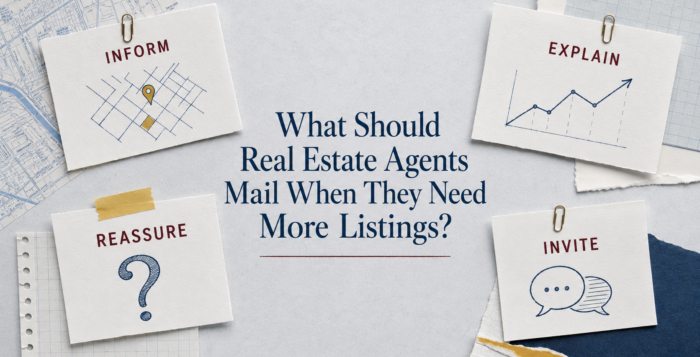
                    So, what should you mail when you need more listings?

                    The best answer depends on how close the homeowner is to making a move.

                    1. Mail Useful Information to Homeowners Who Aren’t Thinking About Selling Yet

                    Most of the homeowners in your market aren’t planning to list their homes today.

                    That doesn’t make them a bad audience. It simply means your first job isn’t to convince them to hire you. It’s to become familiar and useful before they need an agent.

                    Mail that provides everyday homeowner value can help you begin that relationship:

                    • Seasonal home-maintenance information
                    • Local events and community updates
                    • Recipes and holiday content
                    • Home-improvement ideas
                    • Answers to frequently asked homeowner questions
                    • Helpful reports and checklists

                    This type of content gives people a reason to read, save, or display your marketing. It helps your name become familiar without demanding an immediate real estate decision.

                    When something eventually changes in that homeowner’s life, you won’t be introducing yourself for the first time.

                    2. Mail Local Market Information to Homeowners Who Are Starting to Wonder

                    A homeowner may not be ready to sell, but that doesn’t mean they aren’t curious.

                    They may be wondering:

                    What are homes selling for in this neighborhood?

                    Are prices rising or falling?

                    How long are homes taking to sell?

                    Would buyers be interested in a home like mine?

                    This is where local market updates, recent sales, neighborhood statistics, and home-value offers become especially useful.

                    The goal isn’t simply to announce that you know the market. It’s to demonstrate that knowledge by sharing information the homeowner can connect to their own property.

                    Specific local information feels more relevant than a broad statement about the national housing market. It can also give a homeowner the first concrete reason to imagine selling.

                    3. Mail Decision-Making Help to Homeowners Considering a Move

                    Once someone begins thinking seriously about moving, their questions change.

                    The decision is no longer only about what the home might be worth. It becomes about everything surrounding the sale:

                    What should I repair first?

                    How much could I walk away with?

                    Should I sell before buying another home?

                    Where would I go?

                    How disruptive will the process be?

                    Could I wait another year?

                    The National Association of REALTORS® reports that sellers look to real estate professionals for help pricing their homes, reaching buyers, selling within a desired timeframe, and determining what improvements may help the home sell for more. Source: National Association of REALTORS®

                    Mail designed for this stage should reduce uncertainty. Consider offering:

                    • A home-selling preparation report
                    • A downsizing checklist
                    • Information about selling and buying at the same time
                    • A home-improvement planning report
                    • A personalized home-value or equity review
                    • A report to understand potential selling costs

                    This is where your marketing begins moving from general visibility to genuine guidance.

                    You’re showing the homeowner that you understand the decision—not merely the transaction.

                    4. Mail a Clear Invitation to Homeowners Who May Be Ready

                    Some homeowners don’t need another educational article. They need a simple reason to begin the conversation.

                    This is where direct listing-generation messages belong:

                    • Buyers are looking for homes in your area.
                    • Curious what your home could sell for?
                    • Thinking about moving in the next six months?
                    • Let’s create a selling plan that works for you.
                    • Find out what today’s market could mean for your home.

                    The call to action should feel specific and manageable.

                    “Call me for all your real estate needs” is broad and easy to ignore. “Request a no-pressure home-value review” gives the homeowner a clear next step.

                    Make responding feel like the beginning of a conversation—not a commitment to list.

                    Don’t Choose Just One Message

                    The most effective listing campaign may not be a single postcard repeated indefinitely.

                    It may be a sequence.

                    One mailing answers a homeowner question. Another shares local market evidence. The next helps the homeowner explore their options. A later mailing offers a clear invitation to talk.

                    Each message performs a different job, but they all move in the same direction.

                    That’s an important distinction.

                    Random marketing asks homeowners to start over with every mailing. A coordinated campaign allows familiarity, relevance, and trust to build from one touch to the next.

                    Match the Message to the Moment

                    When you need more listings, it’s tempting to make every mailing about your need.

                    But homeowners respond according to theirs.

                    Some need useful information. Some need local evidence. Some need help thinking through a complicated decision. Others need a simple invitation to take the next step.

                    The strongest listing marketing doesn’t send the same message to everyone and hope it reaches someone at exactly the right moment.

                    It creates a series of useful moments—so that whenever a homeowner begins moving toward a decision, your name is already there.

                    Send out a photo introduction postcard.

                    Homes & Life Magazine

                    A customizable magazine with compelling content that keeps you top-of-mind.


                    Magazine →

                    Business Plan

                    Interactive Business Plan

                    Map out your next six months with a simple planner built for real estate success.


                    Get the Plan →


                      One of the easiest traps to fall into during a slower market is trying to save money by doing everything yourself.

                      It’s understandable.

                      Marketing budgets tighten.

                      Expenses matter.

                      So you begin taking on more.

                      Design.

                      Writing.

                      Printing.

                      Social media.

                      Technology.

                      Research.

                      At first, it feels productive.

                      Eventually, it becomes exhausting.

                      Time Isn’t Just Money

                      You’ve probably heard the phrase:

                      Time is money.

                      It’s true.

                      But for a real estate agent, time is something even more valuable.

                      Time creates opportunities.

                      Every hour you spend doing work that someone else could do is one less hour spent:

                      • Meeting potential clients
                      • Building relationships
                      • Prospecting
                      • Following up
                      • Showing homes
                      • Negotiating contracts

                      Those are the activities that generate income.

                      Everything else should support them—not replace them.

                      The Hidden Cost

                      Imagine spending three hours designing a postcard.

                      You saved $75 by doing it yourself.

                      But what if those same three hours could have produced a new client?

                      Or a listing appointment?

                      Or strengthened a relationship that eventually resulted in a referral?

                      That’s the opportunity cost we rarely think about.

                      Ask Yourself One Question

                      Before taking on another task yourself, ask:

                      “Am I doing this because it’s the highest and best use of my time… or simply because I don’t want to spend the money?”

                      Sometimes those are two very different answers.

                      Your Business Grows When You Stay in Your Strengths

                      The most successful agents aren’t necessarily the ones who do the most.

                      They’re the ones who spend the most time doing what only they can do.

                      Put your marketing on autopilot so you can focus on what only you can do: grow your business. Launch an Avoidable Seller Pitfall Campaign.

                        Every year, countless agents make the same decision.

                        The market feels uncertain.

                        Business slows.

                        Vacations, family schedules, and everyday life get busy.

                        So marketing gets pushed aside for “a few weeks.”

                        It seems harmless at the time.

                        But those few weeks are often when future listings begin taking shape.

                        Visibility Isn’t Important…Until It Is

                        Most homeowners don’t spend months planning to sell.

                        A job opportunity appears.

                        The kids move out.

                        Retirement finally feels right.

                        An unexpected life change creates the need to move.

                        When that moment comes, they’re rarely searching for every agent in town.

                        Instead, they think about the agents they’ve noticed recently.

                        The ones whose postcards kept arriving.

                        The names they recognize.

                        The people who looked active long before a yard sign appeared.

                        Visibility creates familiarity, and familiarity creates trust.

                        The Listings You’ll Never Know You Lost

                        One of the hardest things about marketing is measuring what never happened.

                        No homeowner calls to say,

                        “We almost hired you, but we forgot about you.”

                        They simply choose someone else.

                        Not necessarily because that agent had more experience.

                        Not because they offered lower commission.

                        Often because they stayed visible.

                        The listing you never knew existed can be the most expensive one you lose.

                        Consistency Beats Intensity

                        Many agents market in cycles.

                        They send a burst of postcards.

                        Pause for a month.

                        Then start over when business slows.

                        The agents building predictable listing pipelines take a different approach.

                        They don’t rely on motivation.

                        They rely on systems.

                        Their marketing continues whether they’re busy showing homes or taking a well-earned vacation.

                        Because consistency compounds.

                        Each postcard reinforces the last one.

                        Each impression makes the next one more memorable.

                        Opportunity Appears When Others Go Quiet

                        Every time another agent stops marketing, there’s a little less competition for attention.

                        Your postcard stands out more. Your name becomes more familiar. Your brand becomes easier to remember.

                        You don’t have to spend more than everyone else.

                        You simply have to stay present while others disappear.

                        The market will eventually improve.

                        The question is whether homeowners will remember seeing you when it does.

                        Stay visible. Send a Market Update postcard. 

                        Homes & Life Magazine

                        A customizable magazine with compelling content that keeps you top-of-mind.


                        Magazine →

                        Business Plan

                        Interactive Business Plan

                        Map out your next six months with a simple planner built for real estate success.


                        Get the Plan →


                          Real estate agents are no strangers to overthinking.

                          Should you send a postcard or a newsletter?

                          Would another headline work better?

                          Should you change the photo?

                          Would a different neighborhood respond more favorably?

                          Is now even the right time to market?

                          These questions aren’t bad. In fact, thoughtful marketing decisions can improve results. The problem is when planning quietly replaces progress.

                          Many agents spend weeks tweaking a campaign that never gets mailed.

                          Meanwhile, another agent chooses a solid marketing piece, sends it, follows it with another the next month, and keeps showing up in front of homeowners. Six months later, that agent is often the one getting the listing—not because every marketing piece was perfect, but because they became familiar.

                          That’s the part many agents underestimate.

                          Homeowners rarely choose an agent because of one postcard, one email, or one market update. Trust isn’t built in a single moment. It develops over time through repeated, positive impressions.

                          Think about your own life. You’re more likely to hire a business you’ve seen consistently than one you’ve never heard of before. Real estate works the same way.

                          Every time a homeowner sees your name, another small layer of familiarity is created. They notice your market updates. They remember your just listed and just sold postcards. They recognize your name in their mailbox month after month.

                          Individually, those touches may not seem remarkable.

                          Together, they create something powerful.

                          That’s why the agents who consistently market often outperform agents who are constantly searching for the “perfect” campaign. They understand that momentum comes from showing up consistently, not endlessly refining every detail.

                          Does that mean quality doesn’t matter?

                          Of course not.

                          Your marketing should be professional, relevant, and well-designed. But once you have a strong campaign, your time is usually better spent putting it into homeowners’ hands than making another round of small changes that few people will ever notice.

                          The perfect marketing piece doesn’t generate listings if it never leaves your desk.

                          A good marketing piece, delivered consistently, has a chance to build recognition, trust, and eventually, opportunity.

                          If you find yourself spending more time deciding what to send than actually sending it, it may be time to simplify your approach.

                          Scheduled marketing campaigns take the monthly decision-making out of the process, helping you stay visible without having to start from scratch every few weeks. Instead of wondering what to mail next, you can focus on serving clients while your marketing continues working in the background.

                          Perfection feels productive.

                          Progress is what builds a pipeline.

                          Launch a Real Estate Times Scheduled Campaign

                          Homes & Life Magazine

                          A customizable magazine with compelling content that keeps you top-of-mind.


                          Magazine →

                          Business Plan

                          Interactive Business Plan

                          Map out your next six months with a simple planner built for real estate success.


                          Get the Plan →